Using Law to Improve Access to Rare Disease Care


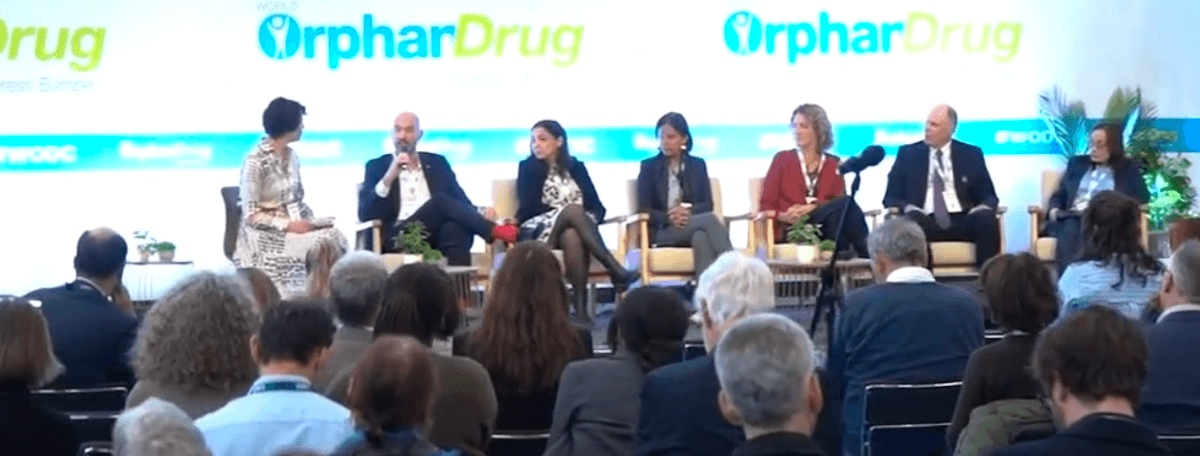
World Orphan Drugs Congress, Amsterdam, October 2026.
Using Law to Improve Access to Rare Disease Care
Presentation delivered at the World Orphan Drugs Congress, Amsterdam, October 2026, by Philippe Pakter, chairman, Pierre Robin Europe
Good morning. I would like to begin my presentation with a story. Imagine that you’re a patient in an EU member state, and your doctor finds a cancerous tumor in your right eye. Your doctor tells you that she can carry out surgery, and remove the entire eye… but she also says that if you travel to another EU member state, you can undergo a different treatment, called proton therapy. Proton therapy would destroy the tumor in your eye, but it would also allow you to keep your eye, and your eyesight.
What treatment would you choose?
Well, the patient in this story – this is a real story – decided that he wanted to undergo proton therapy. So he contacted his national healthcare fund, and he requested permission – what is called “prior authorization” – to undergo this treatment, proton therapy, in another EU member state.
This patient’s national healthcare fund said no. They refused prior authorization; what the healthcare fund was willing to cover was surgery.
My name is Philippe Pakter. I’m a lawyer and a PhD candidate at the University of Geneva. Today, I’ll explain why refusals like this happen, why they hit rare disease patients particularly hard, and how the law could change this, all across Europe.
The patient I spoke of had cancer, not a rare disease, but rare disease patients face this kind of situation on a regular basis. Here’s why. For common healthcare problems, treatment is usually available locally, somewhere in your home country. For rare disease patients, it’s the opposite. A rare disease patient in Spain might need a highly specialized rare disease treatment, which is only offered at a certain university hospital in the Netherlands. A rare disease patient in Sweden might require a multidisciplinary team of experts, who specialize in her rare disease – but that team is located in Italy. There are thousands of rare diseases. No EU member state, however wealthy, can be the top expert on every single one.
There are thousands of rare diseases, and 30 million rare disease patients in Europe, but a common problem they face is difficulties accessing care. In a EURORDIS Rare Barometer survey, 24% of the rare disease patients surveyed said that they went without needed treatment in the past year, because it was not available their home country. Rare disease patients rely on cross-border healthcare in a way that other patients do not.
If you’re in Europe and you need healthcare in another EU country, there are 2 legal routes. The first is the 2011 Cross-border Healthcare Directive. You pay the full cost of the treatment upfront, out of your own pocket. Then you come back home, and ask to be reimbursed. You may get all of it back, or some of it back, or nothing. For eyeglasses or dental work, this level of uncertainty may be okay… but for healthcare involving highly specialized treatments, multidisciplinary teams, and hospitalization, it isn’t very practical.
The second route is Regulation 883. You ask for permission first. That is, you ask your national healthcare fund for prior authorization. If you get it, You travel abroad, receive the treatment, and come back home. The costs are settled between the 2 countries’ healthcare systems. For most rare disease patients, this is the best option.
In order to obtain prior authorization to access a healthcare treatment abroad, you need to meet 2 conditions. The first condition is you have to show your national healthcare fund that there is no local treatment which is the same or equally effective as the treatment which you want to access abroad.
The second condition you must meet is you must show your national healthcare fund that the treatment which you seek abroad is included in your own country’s list of covered healthcare treatments.
Let’s consider these 2 conditions in the context of the case we discussed earlier, the patient who had cancer in his right eye. The first condition: is the local treatment the same or equally effective as the treatment which the patient seeks abroad? Well in this case, the local treatment was surgery, removing the entire eye. This would certainly resolve the cancer, but the patient would lose his eyeball, his eyesight, and his appearance would radically change. Is this “the same or equally effective” as the proton therapy abroad?
Well, clearly it is not. The point is that the “equally effective” analysis must also consider the patient.
For cases involving a rare disease, this question of whether the treatments are the same or equally effective is even harder. Rare diseases disproportionately strike children. They tend to affect multiple systems in the human body at once. They’re often progressive, so the best hope may be to simply slow the progression of the disease. And 2 patients with the same rare disease may respond very differently to the same treatment.
Now the second condition for prior authorization: the treatment abroad must be included in your country’s list of covered treatments. In this patient’s home country, the list included item number 136, “other operations on the eyeball”, and item number 258, “high-technology radiotherapy for oncological and non-oncological conditions.” Proton therapy for a cancerous tumor would certainly fall under the category of “high-technology radiotherapy for oncological conditions”, wouldn’t it? Well, this patient’s national healthcare administrators refused prior authorization. They said that proton therapy was not covered.
This case went all the way up to the European Court of Justice, which decided that when a patient seeks access to a healthcare treatment in another EU member state, the patient’s list of covered treatments determines whether or not the treatment abroad is covered – not whether or not that treatment abroad also happens to be available locally, in the patient’s home country.
The second thing that the court decided is that when the patient’s healthcare administrators read the list of covered treatments, they must read the list in good faith. As the Advocate General put it, “A listed treatment cannot be interpreted in a way which renders it devoid of meaning.”
I would like to emphasize that the Court’s decision in this case did not just affect this one single patient. The Court’s decision set rules for all patients, throughout Europe – and this is something we will return to later.
When it comes to prior authorization for cross-border healthcare, unfounded refusals are a known and longstanding problem. In 2010, the European Parliament declared that the prior authorization procedure “has been abused to deny patients the right to travel to receive healthcare.”
In 2019, the European Parliament issued a Resolution. “Certain prior authorization systems appear to be unduly burdensome and/or restrictive. Insurance companies have discriminated arbitrarily or created unjustified obstacles.”
When healthcare administrators refuse prior authorization, they often argue that cross-border healthcare is expensive, and puts the whole healthcare system at financial risk. The official figures say otherwise. Over the last 10 years, planned cross-border healthcare fell, from 0.05% of total national healthcare spending in Europe, to about 0.02% today. It was even lower during COVID. Not 2%, but 2 hundredths of a percent. And that figure covers all patients, not only rare disease patients. This isn’t a drop in the bucket. This is a drop in the ocean.
We’ve discussed the rules governing cross-border healthcare, but I also want to speak about another rule, Article 21 of the Charter of Fundamental Rights of the European Union. This is the principle of equal treatment and non-discrimination. One of the things it says is that different situations must not be treated in the same way.
A patient seeking routine healthcare services abroad, such as eyeglasses or dental care, is not the same as a rare disease patient seeking access to a highly specialized treatment which does not exist where that patient lives. Applications requesting prior authorization from these 2 patients must not be treated in the same way.
When a rare disease patient requests prior authorization to access a rare disease treatment abroad, local healthcare administrators should not ask, “why should we grant this patient prior authorization?” Rather, for a rare disease patient, the question should be: “why shouldn’t we?” The answer should begin with yes, unless there are good reasons for saying no. For example, serious questions of safety, or efficacy.
When a rare disease patient requests prior authorization, there should be a presumption in favor of access, preferential treatment, and fast processing.
Healthcare administrators should consult the experts, the center of expertise abroad which provides the treatment, as well as experts in the EU’s European Reference Network system.
Healthcare administrators should also consider real-world evidence, not just randomized controlled trials.
And if they decide to refuse the application for prior authorization, healthcare administrators should explain the refusal, in detail. If there’s a local treatment which is the same or equally effective, healthcare administrators should identify what that treatment is, and provide evidence that it is equally effective.
This is not yet the rule. How can it become the rule? First, rare disease patients should apply for prior authorization, and appeal refusals. When one of these cases reaches a national court, that national court can send the case to the European Court of Justice, and the Court’s decision would apply to all rare disease patients, in all 27 EU member states.
Everyone in this room can help. Clinicians, if you are treating a rare disease patient, you can help by writing a detailed letter supporting your patient’s application for prior authorization. Patient organizations can help patients by explaining to them how the prior authorization procedure works, and how to appeal refusals. Members of the European Reference Networks can provide expert advice to national healthcare administrators on rare diseases, and evidence-based treatments. And industry can support the patient organizations which bring these cases forward.
If the European Court of Justice adopts this approach, and facilitates the prior authorization procedure for rare disease patients, the effects could be meaningful. First of all, rare disease patients in Europe would have an easier time accessing life-saving treatments in Europe, regardless of where they happen to live.
Also, improved access to rare disease treatments on the EU level could strengthen the case for industry to invest more resources into rare disease treatment R&D, since more patients would be able to benefit from each treatment.
Rare disease patients in Europe, many of them very young children, shouldn’t have to fight to access safe and effective rare disease treatments, which already exist, and which are already available, right here in Europe.
Thank you very much for your time. I would be very happy to try to answer any questions you might have.
Contact us
We would welcome any feedback you might have. Thank you.
Philippe Pakter, chairman, Pierre Robin Europe